

Quick Summary: OTA commissions are eating into hospitality revenue — and most property owners don’t realise how much until they do the math. This guide covers proven digital marketing strategies for hospitality businesses and accommodations, the channels that drive direct bookings and online reservations, how to reduce OTA dependency, and what hospitality marketing packages actually include. From social media marketing and Google Ads to reputation management and content strategy for travel businesses—everything needed to attract travelers searching for luxury stays, budget stays, or business travel accommodation and build a strong direct booking engine is covered here.
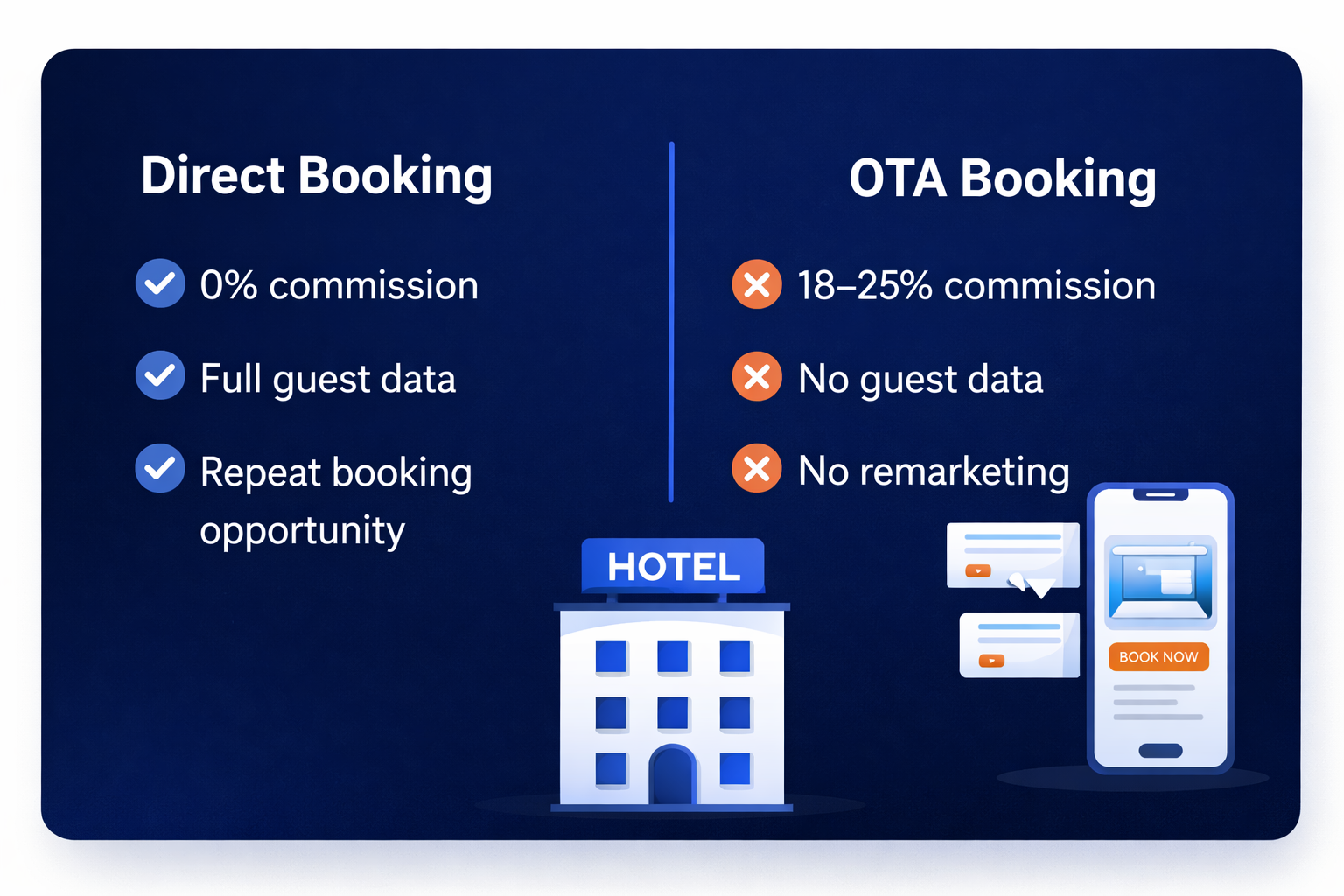
Every time a guest books through Booking.com or Expedia, a property pays a commission of 15 to 30 percent. On a ₹8,000 room night, that’s ₹1,200 to ₹2,400 gone before the guest even checks in. Multiply that across 60 percent of annual reservations, and the impact on revenue becomes impossible to ignore.
Digital marketing for hospitality businesses isn’t just about social media or occasional Google Ads. Done correctly, it shifts bookings from OTA channels — where every guest costs a commission — to your own website and direct channels, where you retain the full revenue and guest relationship.
This guide explains what digital marketing for accommodations actually involves, the business case for prioritizing it, and seven direct booking strategies that consistently increase direct bookings and online reservations for independent properties in 2026.
What Is Hotel Digital Marketing?
Hotel digital marketing is the use of online channels — search engines, paid advertising, social media, email, and content — to attract potential guests, build trust in your property, and convert that interest into direct bookings.
The key distinction between hospitality digital marketing and general online presence is intent. A well-executed property and travel business marketing strategy isn’t built around impressions, followers, or website visits. It’s built around one commercial outcome: a confirmed booking that didn’t require paying a third party to make it happen.
For independent hotels and resorts, this means owning the guest relationship from the moment they first discover the property — through search, social, or content — to the moment they complete a reservation on your website. OTAs are part of the distribution mix, but they should not be the foundation of your revenue strategy. Hotel online marketing, when built correctly, gives you that foundation back.
The hotels consistently growing direct booking share in 2026 treat digital marketing as a revenue function — not a brand awareness exercise.
That’s the data you’d need to run a re-engagement campaign, offer a loyalty discount, or simply send a birthday offer three months later. You get none of it. You get a name and a check-in date.
Rate parity clauses make this harder to work around than most people expect. In many OTA agreements, hotels can’t publicly offer a lower rate on their own website. So even when a guest comes to you directly, you often can’t reward them for doing so — at least not openly.
And here’s the irony that really stings: OTAs spend a portion of the commission they collect from your bookings running Google Ads on your own hotel name. So when a guest who already knows you searches for you by name, an OTA listing sometimes appears above your own website. You funded that ad. You just didn’t place it.
Hotels that have started treating digital marketing as a revenue recovery strategy — rather than a promotional nice-to-have — tend to look at this differently. The question stops being “should we spend on marketing?” and becomes “how much is it costing us not to?”
Benefits of Digital Marketing for Hotels and Resorts in India
The commercial case for hospitality digital marketing isn’t complicated. Every rupee you invest in building direct booking capability reduces your dependency on channels that take a cut of every reservation. Here’s what that looks like in practice:
– Higher Revenue Per Booking
Direct bookings on your own website average significantly more revenue per reservation than OTA bookings — because you retain the commission, control the pricing, and can include add-ons that OTAs don’t support. A single percentage point shift from OTA to direct bookings translates into meaningful bottom-line improvement at scale.
– Full Control Over the Guest Relationship
When a guest books through an OTA, the platform owns the communication. You receive a reservation and a first name. With direct bookings, you own the pre-arrival communication, the preferences data, the post-stay relationship, and every opportunity to earn a repeat visit. Guest lifetime value starts at the first direct booking — not at checkout.
– Long-Term Search Visibility
A hotel that invests in SEO, content, and structured data builds compounding search visibility over time. Unlike paid OTA listings that stop the moment you stop paying, organic search rankings, destination content, and hotel schema markup continue driving discovery long after the initial investment. This is the only marketing channel in hospitality that improves with age.
– Better Targeting With Performance Marketing
Paid digital advertising allows hotels and boutiques in India to go for hyper-specific audience targeting — by location, travel intent, past booking behaviour, and device. A well-structured performance marketing campaign can target guests who visited your website, searched for competitor properties, or responded to seasonal offers — with room-specific creative and a direct booking incentive. OTA advertising doesn’t offer this level of control.
– Measurable ROI Across Every Channel
Every digital marketing channel produces trackable data — cost per booking, channel attribution, conversion rate by source, email open rate, ad ROAS. This gives hotel and resort management teams the ability to make budget decisions based on actual booking outcomes rather than estimated reach and brand sentiment.
– Resilience Against OTA Rate Changes and Algorithm Shifts
OTA platforms change commission structures, listing algorithms, and promotional requirements regularly — and hotels dependent on them absorb every change. A hotel with a diversified digital marketing strategy — SEO, paid, email, social, and content working as a system — is significantly more resilient to shifts in any single channel.e from people who have nothing to sell.
7 Hotel Digital Marketing Strategies to Drive Direct Bookings Without OTAs
These aren’t broad principles. Each strategy below has a specific operational starting point and a clear connection to direct booking outcomes.
A proper hotel marketing strategy starts somewhere most agencies skip: the audit.
- Where are guests currently coming from?
- What does a guest’s journey look like from search to booking confirmation?
- What happens on the website when paid traffic lands?
- What’s the average booking abandonment rate, and at which step?
1. Build a Website That Converts, Not Just One That Looks Good
Your hotel website is the only booking channel where you pay zero commission. Most hotel websites are designed to impress and fail to convert. The difference between a hotel website that drives direct bookings and one that doesn’t is almost never visual design — it’s conversion architecture.
The elements that drive direct bookings on a hotel website:
- A best rate guarantee visible above the fold — not buried in the footer.
- A booking engine that completes in under three clicks on mobile.
- Real room photography — not stock images of generic hotel corridors.
- Clear direct booking incentives — free breakfast, early check-in, complimentary upgrade — that OTAs can’t match.
- FAQ schema and structured data that allows Google and AI-driven search to surface your property’s details directly in results.
If a guest can find a lower rate on Booking.com than on your own website, you have already lost the direct booking before your marketing began.
Your website is your highest-margin booking channel. Treat it like one.
2. Invest in SEO That Targets Booking Intent — Not Just Brand Awareness
OTAs dominate generic hotel category searches — ‘hotels in Udaipur,’ ‘resorts in Goa.’ You cannot outspend them there. Where hotels consistently win organic search is on specific intent queries that OTAs cannot optimise for at scale. Working with the best SEO company in India that understands hospitality search behaviour makes the difference between page one rankings that generate enquiries and content that exists but doesn’t convert.
The queries that drive direct bookings from organic search:
- ‘Boutique hotel near [landmark] with pool’
- ‘Heritage resort [city] for couples’
- ‘Family hotel [destination] with kids activities’
- ‘Pet-friendly stay [area]’
These searches convert at a significantly higher rate because the traveller already knows what they want. Build location-specific landing pages, implement Hotel and FAQ schema, and publish destination content that answers the real questions guests ask before they book. Google’s AI Overviews now pull FAQ content directly into search results — hotels without structured content are invisible in this layer of search.
Generative AI tools like ChatGPT and Perplexity are increasingly used by travellers to discover and shortlist properties, which means the same structured, intent-rich content that wins Google rankings also improves your visibility in AI-generated travel recommendations.
3. Run Performance Marketing That Works the Booking Funnel
Most hotel paid campaigns target the wrong stage. Broad awareness campaigns generate impressions. What generates bookings is targeting guests at the point of decision. A full-funnel performance marketing strategy for hospitality industry operates across three layers simultaneously:
- Brand keyword defence: OTAs actively bid on your hotel’s name in Google Ads. Without your own brand campaign, guests who search for you directly are being captured by OTA listings at your expense. A brand campaign at ₹500 to ₹1,500 per day protects your highest-intent traffic.
- Retargeting: Guests who visited your website, viewed a room, or started a booking and didn’t complete it are your hottest audience. Retargeting campaigns on Google Display, Facebook, and Instagram with room-specific creative and a direct booking incentive consistently produce the lowest cost per confirmed booking.
- Lookalike audience expansion: Build lookalike audiences from past direct bookers and deploy them on Meta and Google for new acquisition. These guests share characteristics with people who have already chosen to book directly — the conversion rate is significantly higher than cold audience targeting.
Google Hotel Ads — the metasearch layer that shows your rates directly in Google Search and Maps alongside OTA rates — is one of the most underused paid channels in hotel marketing. Appearing here with a competitive direct rate is often the last step before a guest decides where to book.
Set a cost-per-booking benchmark before any campaign goes live. If the campaign cannot produce a confirmed booking at a cost that makes commercial sense against your ADR, the budget needs reallocation — not scaling.
4. Use Social Media as a Discovery and Trust Engine
Social media for hotels is not a content calendar exercise. Instagram and TikTok content is now indexed by Google — a well-optimised short-form video of your property can surface in travel intent searches and Social Media in AI Search results. A consistent social media marketing agency for hotels builds content across three types that directly influence booking decisions:
- Make the most of UGC marketing— User-generated content from real guests: reposted with permission, this is the most trusted content format in tourism and hospitality. A guest video of your rooftop view at sunset converts better than any produced brand content. So, simply put,turn guests into marketers
- Experience-first short-form video: what does it actually feel like to arrive at your property, wake up in your room, eat at your restaurant? These videos answer the questions guests have before they book and can’t answer from static photography.
- Local destination content: content that positions your hotel as the authority on your destination — what to do, where to eat, seasonal experiences — builds organic search visibility and gives guests a reason to save, share, and return to your profile.
Facebook remains relevant for retargeting older traveller demographics and for direct booking campaign integration. Facebook marketing campaigns with ‘Book Now’ buttons linked directly to your booking engine — not your homepage — reduce the friction between social discovery and confirmed reservation.
5. Manage Your Reputation as a Revenue Asset
Review platforms are not customer service channels. They are ranking signals. Google, AI Overviews, and OTA listing algorithms factor review recency, volume, sentiment, and response rate into where your property appears in results. A hotel with 150 recent reviews with consistent responses outranks a hotel with 600 reviews from three years ago that were never answered — regardless of marketing budget.
The operational standard that protects and improves your search position:
- Respond to every review — positive and negative — within 24 hours, across Google, TripAdvisor, and Booking.com.
- Build a post-stay email sequence for direct bookers that requests feedback and routes satisfied guests to your preferred review platform.
- Monitor review sentiment weekly, not monthly. A recurring complaint in reviews is a product problem that marketing cannot fix — but catching it early limits the ranking damage.
Reputation is the one marketing channel where the quality of your product does the work. Everything else amplifies it.
6. Own the Guest Relationship Through Email and WhatsApp Marketing
When a guest books through an OTA, the platform owns all communication. You receive a reservation reference and a first name. Building direct communication channels — email and WhatsApp — is the mechanism that converts OTA guests into direct bookers over time.
Email generates ₹38 in revenue for every ₹1 spent in hospitality. WhatsApp open rates exceed 90% — three to four times higher than email alone. The strategy that works:
- Collect contact details at every touchpoint: booking confirmation, check-in, wifi login, post-stay feedback form. Build a first-party guest database that you own, not one locked inside an OTA platform.
- Segment by guest type and booking history: leisure versus business, couples versus families, first-time versus returning. Segmented campaigns consistently outperform batch sends on every metric.
- Run seasonal re-engagement campaigns: guests who previously booked through OTAs and provided contact details at check-in are your most convertible direct booking audience. A well-timed offer with a direct booking incentive moves a significant percentage of them to book direct on their next visit.
The content strategy behind these communications matters as much as the channel. Generic promotional emails don’t convert. Personalised pre-arrival messages with local recommendations, exclusive in-stay offers, and post-stay content that makes guests feel known — these build the relationship that OTAs structurally cannot.
7. Create Content That Captures Demand Before the Comparison Stage
Travelers spend an average of 45 days researching before making a hotel booking and visit over 100 pages of travel content in that window. A hotel that only appears on OTAs enters the guest’s consideration at the comparison stage — when price is the primary differentiator and your margins are already under pressure.
Content marketing for hotels is the direct booking strategy that captures intent before the comparison begins. The formats that produce direct booking traffic:
- Destination guides: comprehensive, SEO-optimised content covering the best experiences, restaurants, activities, and local knowledge near your property. These rank for destination searches and position your hotel as the authority on the location.
- Experience-specific landing pages: ‘honeymoon packages [city],’ ‘corporate offsite venues [area],’ ‘wellness retreat [destination]’ — pages built around specific travel intentions with a clear booking path.
- Seasonal and event content: content tied to local festivals, peak travel windows, and seasonal experiences that captures demand at the exact moment guests are planning.
Every piece of content should link directly to your booking engine — not your homepage. The path from content discovery to confirmed reservation needs to be as short as possible. A well-optimised destination guide can drive direct booking traffic for three to five years without ongoing ad spend. No other marketing channel in the accommodation industry offers that return profile
What Do Hotel Digital Marketing Packages Actually Cost?
One of the first questions most hotel owners ask is straightforward: what does this cost, and what do we get for it?
Here’s how digital marketing packages for hotels typically break down at WriterzDen:
Starter — ₹20,000 onwards/month
Built for smaller independent properties or boutique hotels that need a foundation before scaling. Includes:
- Google Business Profile management and optimisation
- 4-6 social media posts per month — Instagram and Facebook marketing, including static creatives, reels, hashtag research, copy, editing, content, and graphic design
- Competitor research and basic content strategy
- Ad campaign management (Meta Ads) — ad running charges billed separately by Meta
- Monthly performance reporting and review monitoring
Growth — ₹25,000 onwards/month
The most common starting point for mid-scale hotels and properties actively working to reduce OTA dependency. Includes:
- 8–12 social media posts per month — Instagram marketing, Facebook marketing, Reel creation, social media content, and graphic design
- Monthly content calendar with competitor research
- Ad campaign management (Google Ads + Meta Ads) — ad running charges billed separately by Google and Meta
- Bi-weekly performance reporting
Pro — ₹35,000 onwards/month
For hotel chains, resorts, or properties with higher occupancy targets and active seasonal campaigns. Includes:
- 16–20 social media posts per month — Reel creation, Instagram marketing, Facebook marketing, social media content, graphic design, and Stories
- Competitor research, UGC campaigns, and influencer coordination
- Ad campaign management (Google Ads, Google Hotel Ads, and Meta Ads) — ad running charges billed separately by Google and Meta
- Weekly reporting with revenue attribution
Ad campaign management is included in all packages. Ad running charges — what Google or Meta actually bills per click or impression — are separate and billed directly by the respective platform. This keeps your ad spend fully transparent and under your control, with no markup from the agency side.
For properties that aren’t sure which tier fits, a one-time audit and strategy session can clarify exactly which channels to prioritise and what a realistic direct booking target looks like for your property size and market.
Need Help with Digital Marketing for your Hotel or Resort?
WriterzDen offers hotel and resort digital marketing services including SEO, social media marketing, content strategy, performance marketing, and online reputation management for hotels, resorts, and boutique properties across India.
How WriterzDen Approaches Digital Hospitality Campaigns & Outreach
WriterzDen is one of the best full-service hotel marketing agencies in India, having worked with guest-experience industry brands across the globe. With proven solutions, we have helped them reduce their dependence on OTAs and build sustainable direct booking channels. We don’t offer generic digital marketing packages — we build channel-specific strategies around the commercial objectives that actually matter in hospitality: direct booking rate, cost per booking, and guest lifetime value.
What we bring to a hotel digital marketing engagement:
- SEO and content strategy: destination content, hotel schema implementation, location-specific landing pages, and technical SEO built around booking intent queries — not just brand visibility.
- Performance marketing: full-funnel paid campaigns across Google Search, Google Hotel Ads, Display, and Meta — with brand keyword defence, retargeting architecture, and cost-per-booking benchmarking from day one.
- Social media management: content strategy, UGC curation, short-form video, and direct booking campaign integration across Instagram, Facebook, and emerging platforms.
- Email and WhatsApp strategy: first-party database building, guest segmentation, seasonal campaigns, and pre-arrival and post-stay communication sequences.
Every engagement starts with an audit of your current booking mix, channel attribution, and the specific points in your guest journey where OTA dependency is highest. The strategy we build is designed around closing that gap — not around running campaigns for the sake of activity.
If your hotel is generating demand but not converting it into direct bookings, that gap has a specific cause. Let’s identify it. Not sure if you need an agency yet? Read our breakdown on digital marketing agency vs in-house — the situations where managing marketing without professional support is actively costing revenue.
Frequently Asked Questions
1. What is the most effective digital marketing strategy for hotels to get direct bookings?
There is no single most effective strategy — the right mix depends on your property type, location, and current booking mix. That said, the combination that consistently produces the strongest direct booking growth is website conversion optimisation paired with brand keyword defence in paid search and a post-stay email re-engagement strategy. These three work together to capture high-intent guests, protect them from OTA interception, and convert past OTA bookers into direct guests over time.
2. How long does it take for hotel digital marketing to show results?
Paid campaigns — Google Ads, Meta retargeting — produce measurable results within the first 30 to 60 days. SEO and content marketing take 3 to 6 months to build meaningful organic traction, but the returns compound over time unlike paid channels. Email and WhatsApp strategies begin producing results as soon as a guest database is established. A realistic expectation for a hotel starting a digital marketing strategy from scratch is measurable improvement in direct booking share within 90 days, with compounding returns over 12 months.
3. Is digital marketing for travel and leisure business worth the investment if we already get bookings through OTAs?
The question isn’t whether OTA bookings are coming in — it’s what each one is costing you. If 60 percent of your bookings carry a 20 percent commission, the commercial case for shifting even 15 to 20 percentage points of that to direct is significant at any room rate. Digital marketing for hotels isn’t a replacement for OTAs — it’s the strategy that reduces your dependency on them and improves the margin on every booking in your mix.
4. What is the difference between hotel digital marketing and hotel advertising?
Hotel advertising is a component of hotel digital marketing — specifically the paid channel. Hotel digital marketing encompasses everything from SEO, content, social media, email, and reputation management through to paid search and display advertising. A paid-only approach produces results while the budget runs. A full digital marketing strategy produces compounding results that don’t stop when you stop spending.
5. Can a small independent hotel compete with large chains using digital marketing?
Yes — and in several areas, independent hotels have an advantage. Chain hotels must maintain brand standard consistency across hundreds of properties. An independent hotel can create hyper-specific, locally authentic content, respond to guests personally, and build a direct relationship that a chain property structurally cannot. The constraint for independent hotels is usually budget and expertise — both of which a specialist hospitality digital marketing agency addresses.
