

Quick Summary: Industrial SEO and digital marketing help B2B manufacturers capture procurement managers who spend 83% of their journey researching online. By targeting high-intent technical specifications, structuring websites for enterprise buyers, and integrating performance marketing, manufacturers build a predictable inbound RFQ engine.
The trade show circuit used to be where manufacturing relationships were made. A booth, a catalogue, a handshake — and a pipeline of enquiries to follow up over the next quarter. For manufacturers across India, that model still works. What it no longer does is scale — and that is precisely where engineering SEO and B2B digital marketing services for manufacturing have become the competitive divide.
Global supply chain buyers — procurement heads, engineering managers, sourcing directors — now run their shortlisting process online before any direct contact is made. They search for technical specifications. They compare manufacturer capabilities. They evaluate certifications, production capacity, and case studies on a company website before deciding whether the business is worth a conversation.
The manufacturer that doesn’t show up in that process doesn’t get shortlisted — not because its product is inferior, but because it was invisible at the moment the buyer was looking. And this is where manufacturing SEO becomes a vital growth driver.
A manufacturing SEO agency builds the search infrastructure that makes manufacturing companies visible to those buyers at exactly that moment. Paired with a structured B2B lead generation funnel, it turns organic search into a predictable source of qualified enquiries — RFQs, specification requests, and enterprise-level conversations that trade shows alone cannot consistently produce.
The manufacturers already capturing this opportunity understand that proven digital marketing strategies for industrial growth look fundamentally different from consumer marketing — and require a different strategic framework from the ground up.
Why Traditional Marketing Falls Short for Manufacturing Businesses
Trade shows, cold outreach, and distributor networks have built umpteen successful manufacturing businesses. The ceiling they hit isn’t a question of effort — it’s a structural one. Each of these channels is reactive, relationship-dependent, and geographically limited in ways that digital channels are not.
The more significant problem is the buyer journey. Engineering and procurement heads responsible for sourcing high-value industrial components, heavy machinery, or specialised manufacturing services don’t respond to cold outreach the way they did a decade ago.
They research independently, often for weeks, before making any direct contact. The business that hasn’t invested in specification-driven SEO has no presence in that research phase — and by the time the buyer reaches out to the companies on their shortlist, the invisible manufacturer isn’t on it.
Generic digital marketing compounds the problem. Broad keyword targeting and generic blogging fail to convince engineering leads. Effective technical content writing for manufacturers requires deep subject-matter expertise — translating complex engineering specs, ISO standards, and material tolerances into precise industrial copywriting that procurement teams trust.
A procurement manager searching for ‘custom CNC machined components with ISO 9001 certification’ is not the same buyer as someone searching for ‘CNC machining services.’ Digital marketing for manufacturing companies that actually generates enquiries is built around this distinction — not around reaching the widest possible audience, but reaching the right one at the right stage of their decision.
The most consistent gaps in traditional industrial marketing:
– Over-reliance on agents and distributors who control the buyer relationship and limit the manufacturer’s direct market intelligence.
– Trade show dependency producing cyclical pipeline spikes with nothing in between to maintain visibility or generate inbound interest.
– Websites built for brochure purposes rather than conversion — no product-specific landing pages, no downloadable specs, no clear RFQ path.
– No industrial marketing strategy for search — which means the business is invisible to the procurement managers actively researching suppliers online right now.
– Invisibility in AI Search (AEO & GEO): Failing to structure technical specs for AI search engines like ChatGPT and Google AI Overviews, leaving your brand out of the initial supplier shortlists generated by automated procurement queries.
Without targeted SEO for manufacturing companies, an industrial website remains a passive online brochure rather than an active lead generation channel.
The manufacturers winning global B2B buyers online aren’t outspending competitors. They’re showing up for the searches that matter with the content that converts.
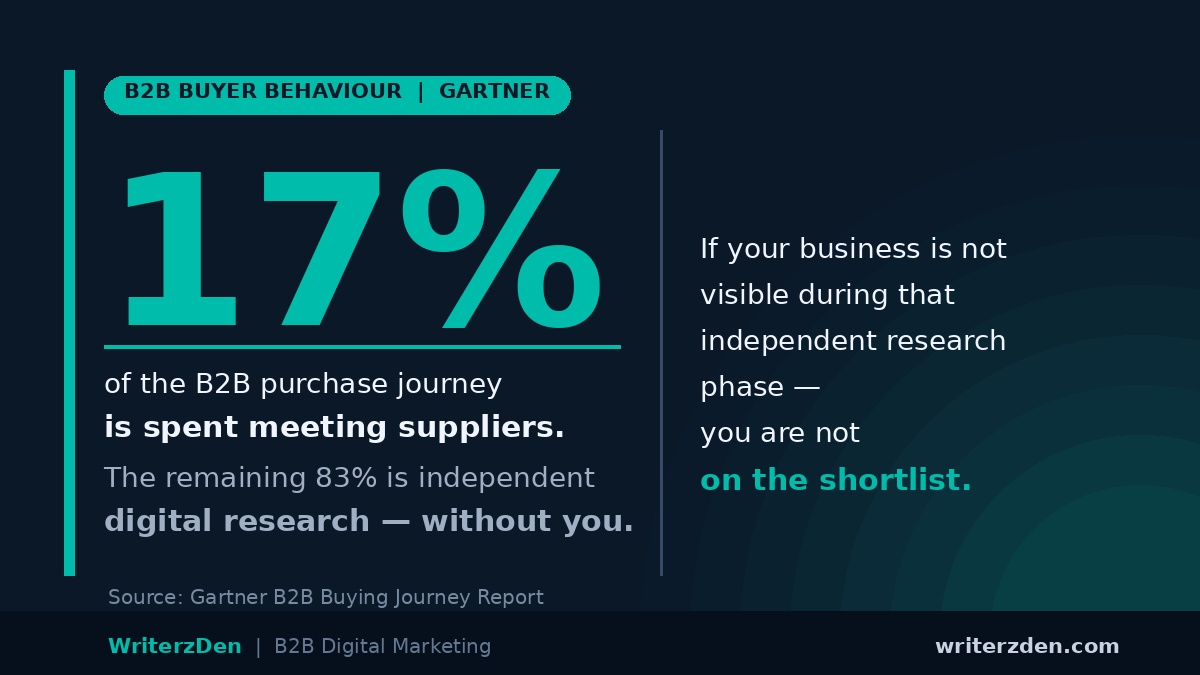
The numbers confirm what most manufacturing businesses are already sensing. According to Gartner’s B2B Buying Journey Report, B2B buyers spend just 17% of their total purchase journey meeting with potential suppliers — dedicating the remaining 83% to independent digital research. For a manufacturing business with no search presence, that research phase is happening entirely without you.
*Source: Gartner B2B Buying Journey Report Analysis via Growth Method
Building a Commercial SEO Engine That Ranks Nationally
In B2B SEO, manufacturing brands face a fundamentally different landscape than consumer brands: buyer search behavior is specification-driven, not discovery-driven. A consumer searches broadly and narrows.
A procurement manager searches specifically — product category, technical requirement, certification, geography, lead time — and evaluates what surfaces against a checklist of supplier qualification criteria. Working with a top industrial SEO agency that understands this distinction is what separates separates tailored manufacturing company SEO from generic search campaigns that produce traffic without qualified enquiries.
Targeting High-Intent Technical Terminology
Broad product keywords — ‘industrial valves,’ ‘engineering components,’ ‘chemical manufacturer’ — are dominated by directories, aggregators, and large OEMs with decades of domain authority. Ranking for these terms requires resources most mid-sized manufacturers don’t have and a timeline that doesn’t serve immediate lead generation goals.
The core of high-intent manufacturing SEO lies in technical terminology — targeting specific product configurations, materials, tolerances, certifications, and application contexts that global supply chain buyers search when actively sourcing. Examples of the queries that convert:
– ‘Duplex stainless steel flanges ANSI 150 manufacturer Gujarat’
– ‘GMP-certified pharma contract manufacturer Ahmedabad’
– ‘SEO for heavy machinery manufacturers in India’
– ‘CNC precision components tight tolerance ISO 9001 supplier’
These searches have lower volume and significantly lower competition than generic category terms. More importantly, they represent buyers who already know what they need and are evaluating suppliers — not exploring options. Building a keyword architecture around this specificity creates a search footprint that matches how procurement decisions are actually made.
Optimising Site Architecture for Enterprise Buyers
The structure of a manufacturing website is as important as its content for B2B SEO.
Enterprise buyers evaluate vendor websites for credibility signals before they read a word of copy — and those signals are structural: clear product category navigation, dedicated pages per product line with full technical specifications, downloadable datasheets, certification pages with visible accreditation, and case studies that demonstrate capability in relevant application contexts.
Optimising technical specifications for featured snippets is one of the highest-return activities available to manufacturers investing in SEO — structured data around product specs, MOQs, and certifications surfaces directly in search results and answers the buyer’s qualification questions before they click.
A structured content ecosystem — where pillar pages cover broad product categories and cluster content covers specific applications, materials, and use cases — builds the topical authority that positions a manufacturing website as the most comprehensive resource in its category. This is what produces compounding search visibility over time, rather than individual pages competing independently.
Domain authority built through high-tier backlink building strategies from industry publications, trade associations, and technical directories reinforces the on-page work — telling search engines that the site is a trusted source in its category, not just a well-optimised one.
All Set to Capture High-Intent B2B Manufacturing Buyers?
Let WriterzDen’s expert team build a specification-driven SEO and lead generation engine for your manufacturing brand.
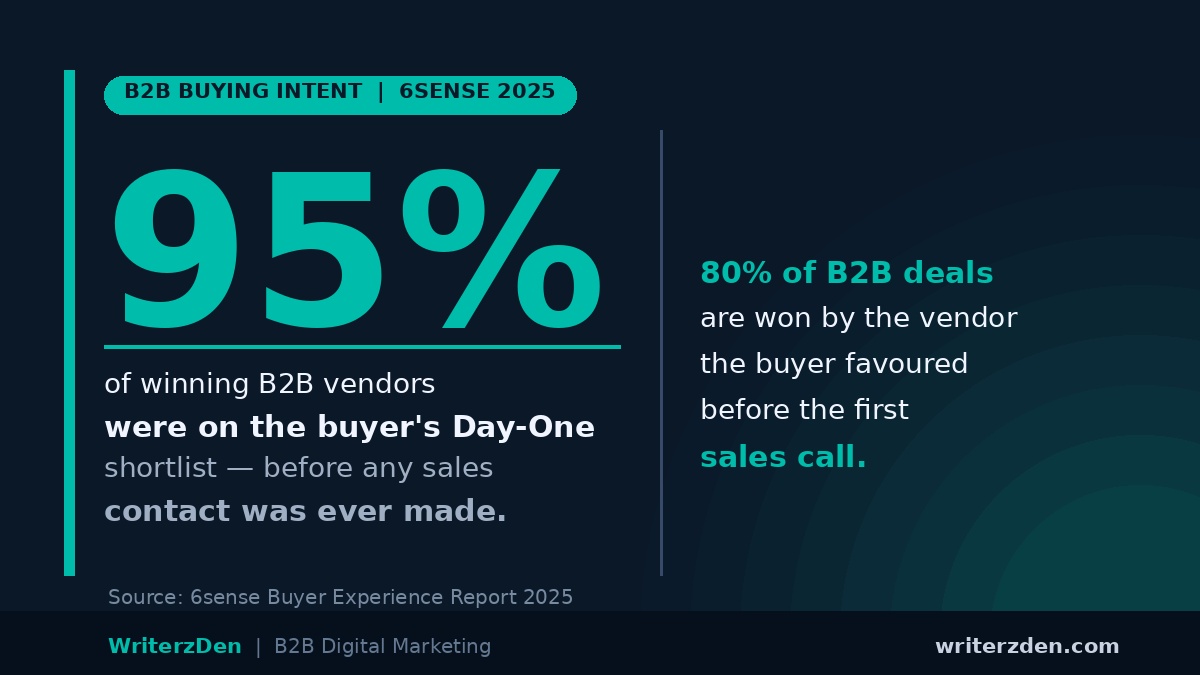
The 6sense Buyer Experience Report 2025 puts the stakes into sharper focus: 95% of winning B2B vendors were already on the buyer’s Day-One shortlist before any sales conversation took place. The shortlist is built during the digital research phase — which means organic search visibility and credible site architecture aren’t marketing activities, they are pre-sales infrastructure.
*Source: 6sense Buyer Experience Report via Omnibound B2B Statistics
Structuring B2B Manufacturing Lead Generation Funnels for Long Sales Cycles
Industrial B2B sales cycles are long — weeks to months between first contact and purchase order in most manufacturing categories. The lead generation funnel that works for this cycle looks different from any consumer marketing model. Each stage requires different content, different conversion objectives, and different measurement frameworks.
From Technical Research to RFQ Submission
At the top of the funnel, B2B manufacturing content marketing focuses on technical authority — producing detailed application guides, material comparison sheets, and compliance breakdowns. Partnering with a specialized manufacturing content writing agency in India ensures these technical assets speak the exact language of plant managers and sourcing directors.
These pages attract buyers in the early research stage, when they’re defining requirements and building a supplier longlist. The goal at this stage is not conversion — it’s credibility establishment and returning visit generation.
Mid-funnel content shifts to capability demonstration: detailed product pages with specifications, production capacity information, quality certifications, and case studies showing successful delivery in comparable applications. This is where the shortlist decision happens — the buyer is narrowing from five potential suppliers to two or three. Missing this layer means the business gets found at the research stage and then lost to competitors who have more credible mid-funnel content.
Bottom-funnel conversion architecture is where most industrial websites fall short.
Getting a procurement manager to submit a Request for Quotation requires reducing friction at every step: a clearly signposted RFQ form built around the technical parameters they need to specify, a response time commitment, and a clear indication of the process that follows submission.
Buyers who are ready to submit an RFQ are at the highest point of intent — the conversion rate on a well-built bottom-funnel page is significantly higher than any top-funnel content, and the cost of a poorly built one is a qualified buyer who went to a competitor’s simpler form.
Ready to Turn Technical Search Volume into Qualified Manufacturing RFQs?
Partner with WriterzDen to build a predictable, high-intent lead engine for your industrial brand.
Integrating Content With Paid Amplification
Organic search builds the long-term lead generation engine. Results-driven industrial performance marketing accelerates it. The highest-ROI integration for manufacturing B2B is retargeting: capturing visitors who arrived through organic search and consumed technical content, and re-engaging them with more specific capability content or direct RFQ prompts across Google Display and LinkedIn.
Top performance marketing agencies in India working with industrial clients build this integration as a standard component of the digital marketing architecture — not as a separate paid media campaign running independently of organic traffic.
LinkedIn’s targeting capabilities are particularly valuable in industrial B2B — job title targeting by procurement function, industry, and company size produces remarkably clean audiences for technical content promotion and RFQ campaign amplification.
A manufacturer running LinkedIn campaigns to engineers and sourcing managers at target accounts in specific geographies can build brand familiarity with exactly the right buyer segments before those buyers run their next supplier search.
The industrial businesses generating consistent inbound RFQs aren’t running more campaigns. They’ve built a content and SEO infrastructure that meets the buyer at every stage of their procurement process.
Frequently Asked Questions
How long does technical SEO for OEMs take to generate qualified B2B leads?
Meaningful organic lead volume typically appears between 4 and 8 months from a standing start, with the full compounding effect visible at 12 months. The timeline depends on current website authority, keyword competitiveness, and content production pace. Unlike paid campaigns, the leads don’t stop when the budget stops — a well-ranked product page continues generating RFQ enquiries long after the initial investment.
What is the difference between consumer e-commerce SEO and industrial SEO?
Consumer SEO targets transaction intent — someone who knows what they want and needs a place to buy it. Industrial SEO targets specification intent — a procurement manager evaluating whether a supplier meets a complex technical requirement. The keyword strategy, content depth, site architecture, and conversion objectives are fundamentally different, and so are the success metrics: RFQ quality and average order value rather than revenue per session.
Why should manufacturers invest in domain SEO if they already list products on industrial marketplaces and directories?
Industrial directories list dozens of competing suppliers on the same page, often triggering price-driven bidding wars. Specialized SEO service providers for the manufacturing sector focus on building owned domain authority. This allows manufacturers to capture high-value procurement traffic directly on their own site, establishing brand trust before buyers even look at aggregators.
How should B2B manufacturers structure their search marketing budget to maximize ROI?
Unlike B2C marketing that relies on massive ad spend to reach broad audiences, industrial SEO budgets should focus heavily on high-intent technical content creation and specification-driven site architecture. Working with SEO firms specialising in manufacturing industry allows mid-sized manufacturers to direct budget specifically toward bottom-funnel technical keywords rather than wasting resources competing for high-volume, generic consumer terms.
How do manufacturers track ROI from organic lead generation?
The measurement connects three layers: search console data showing which queries drive traffic, analytics data showing which pages produce RFQ submissions, and CRM data showing which enquiries convert to purchase orders and at what value. A reliable cost-per-qualified-lead figure from organic search typically requires 6 to 12 months of data — but once established, it’s the most useful benchmark for allocating budget across organic, paid, and trade show channels.
What should industrial companies evaluate when choosing a digital marketing firm?
Manufacturers should prioritize agencies with proven experience in technical SEO, specification-driven site architectures, and B2B lead funnel tracking. Leading digital marketing firms for manufacturing businesses in India focus on generating measurable RFQs, high-value quotation requests, and multi-channel retargeting across LinkedIn and Google Display rather than superficial website traffic
How do Generative Engine Optimization (GEO) and AI search engines impact industrial B2B lead generation?
Modern procurement teams use AI search tools like Google AI Overviews, ChatGPT, and Perplexity to shortlist suppliers. Structuring ISO certifications and technical specs for AI visibility through Generative Engine Optimization (GEO), Answer Engine Optimization (AEO), and LLM Optimization (LLMO) ensures AI models parse, cite, and recommend your facility during early-stage buyer research.
About WriterzDen
Based in Ahmedabad, WriterzDen is a leading manufacturing SEO company in India, established in 2014. As an omnichannel digital marketing agency, our experts specialise in translating complex industrial specifications, compliance standards, and B2B buyer journeys into high-converting digital search funnels.
By bridging the gap between technical expertise and commercial intent, we help enterprise manufacturers expand beyond traditional trade shows into predictable online channels. Today, WriterzDen is recognized among the best SEO companies for manufacturing businesses in India, helping industrial brands build measurable B2B lead generation engines through search — not just a passive digital presence.
